
COACHING PLAYERS: DIFFERENT NEEDS, DIFFERENT APPROACHES
The coaching tightrope: balancing technical instruction with autonomy

As coaches, we’ve all felt that familiar tug-of-war during a practice session. On side A of the court, you have players struggling with the fundamentals—they need constant external cues and help identifying why the ball didn’t go where they intended. On side B of the court, you have your veteran players with high technical proficiency who are hungry for that next 1% of growth.
Recently, I have heard the dreaded feedback: “Coach, I feel like I’m not getting enough attention.” To be honest, it was a tough pill for me to swallow. But after giving it some thought I’ve concluded that it isn’t that I’m not working hard enough, I must do things differently. Finally, it dawned; These two groups require two completely different modes of coaching.
The solution: The “consultant vs. instructor” model
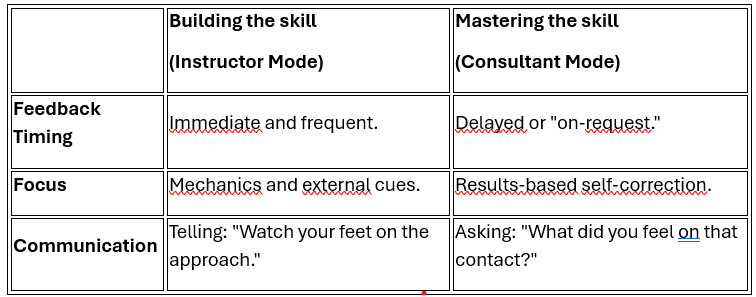
There is a distinct difference between the two groups. Group A is focused on skill building while Group B is focused on skill mastery. To address the “lack of attention” complaint, I must change the type of attention I give. If I try to give “Instructor” energy to everyone as the only coach on the court, I will burn out, and my better players will feel micromanaged while my developing players feel ignored.
- The instructor mode (for building skills). For the players who are still building their skills, I’m going to be loud and frequent with my feedback. I’ll give them feedback and cues (like ‘keep your platform quiet’) because I’m acting as their eyes until they learn to feel those movements themself. I’m their mirror and provide the observation they can’t yet see for themselves.
- The consultant mode (for mastering skills). For those players who have a high level of technical proficiency, I’m actually going to step back a little bit, on purpose. If they already know the ‘how,’ my job isn’t to talk in their ear every rep. My job is to let them use their own cues and learn from the observed result of the ball (trajectory). I’ll tell them that if I’m ‘quiet’ while they’re executing a skill, it’s because I’m trusting their brain to self-correct. In a real match, I’m not on the court with them; they need to be their own best coach. When necessary, I’ll still be there to push their decision-making and strategy, but I’m giving them the space to own their game. I’m more of an architect, creating the environment with relevant constraints to force them to adapt their skills, using their own cues.
The planned strategy: The “office hours” rotation
Instead of trying to watch all players simultaneously, I am going to divide my practice blocks by feedback style:
Instructional block: I will be dedicating my high-intensity focus to Group A. Give them the repetitive, external cues and feedback they need to build muscle memory.
The “consultant” check-in: Meanwhile, I will give Group B a high-rep, goal-oriented drill (e.g., “Score 10 points hitting into the deep corners”). And I’ll tell them: “If you ever feel stuck or need a second pair of eyes, my ‘office’ is always open—just ask.”
The flip: Switch roles. Now, challenge Group B with a high-speed game scenario where you only offer feedback on their process and decisions, while Group A works on a high-volume technical station.
Putting it to practice in a serve/receive drill
Group A (skill building) is the receiving side. Their focus will be on moving to cut off the ball trajectory before it reaches the 10 feet line on the other side (using the step-shuffle) and have their platform out and angled towards the setter before the ball crosses the net. I will provide feedback on the start of their movement (early, on time, late) and whether their platform is angled on time to the setter (too early, on time, too late, angled or not angled).
Group B (skill mastery) is the serving side. Their focus will be on hitting float serves (zero spin), below antenna height, into the 1/6 seam or 5/6 seam. Their observations are: spin or no spin, height is right or too high, and in or outside the ordered seam. In order to reach the objectives these players have to hit the middle of the ball with the stiff palm of their hand (zero spin), hit the ball in front of their hitting shoulder and in front of their body, and square their hips and shoulders towards the ordered seam. The players know what to look for and know what they can adapt in their movements to reach the objectives.
After a certain amount of time, I’ll switch sides and roles. Group B (skill mastery) will be the receiving side. The focus will be on calling out seams, passer coverage in the seams, and pass quality. The drill starts at 17-23. For each 3-pass Group B will receive 1 point but for each 1-pass or 0-pass one point will be deducted. And one extra point is given for passer coverage in the seams. Group A (skill building) can only score by hitting an ace or a serve that cannot be controlled at first contact.
Making it transparent
After having swallowed the tough pill and having decided on the course of action to follow in the future, I think that the best way to stop the previously mentioned complaints is to talk with the players about it;
- Every player will get the type of attention that will make them a better volleyball player the fastest.
- Nobody is being ignored. My “silence” towards the group that is mastering the skill isn’t a lack of interest, it’s a sign of trust in their technical knowledge. I’m giving them the space to use their own cues because that’s how they’ll get better in a high-pressure match when I’m not standing next to them.”. You are simply giving them the type of attention that will make them a better volleyball player the fastest.
Evaluation
This plan, this strategy has not yet been tested by me. Practices will resume on Jan, 5th. At the beginning of February Ill give you an update on the “consultant vs. instructor” model.